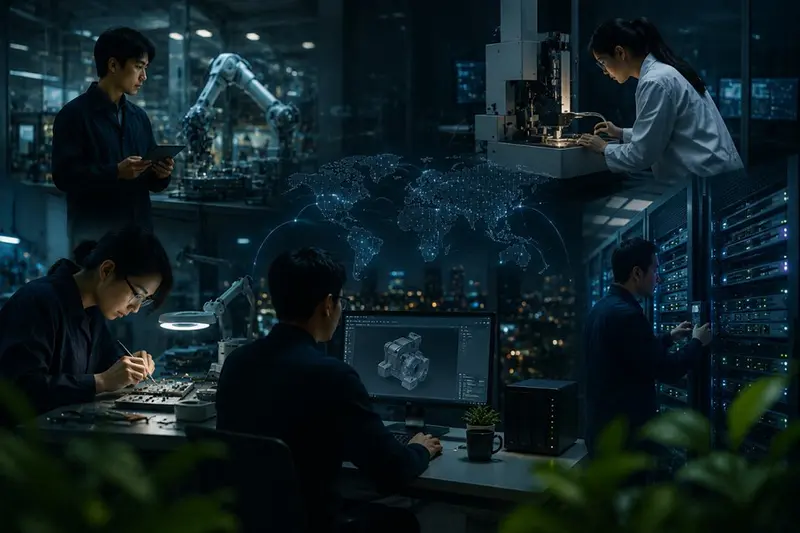
For years, the technology industry celebrated a very specific type of company.
The biggest names were often the loudest innovators — businesses associated with disruption, rapid growth, massive valuations, and constant visibility. Success became closely tied to public momentum. Companies competed aggressively to dominate headlines, attract attention, and expand into as many markets as possible.
For a long time, that strategy worked remarkably well.
Social media transformed communication. E-commerce reshaped retail. Streaming altered entertainment permanently. Artificial intelligence accelerated productivity and automation across industries. The modern economy increasingly organized itself around digital ecosystems built by highly visible technology giants.
Yet beneath this era of high-profile disruption, another category of companies has quietly started reshaping the future of technology in ways many consumers rarely notice directly.
These are not always the businesses dominating public conversation.
They are the companies building the infrastructure, trust systems, operational intelligence, cybersecurity frameworks, cloud environments, and enterprise technologies modern economies increasingly depend on every day.
In many ways, the next major winners in technology may not necessarily be the most visible consumer brands.
They may increasingly be the organizations quietly making the digital world function reliably behind the scenes.
This shift matters enormously because it reflects a deeper transformation happening across the global economy.
For years, technology markets rewarded expansion above all else. Growth signaled leadership. Scale created competitive advantage. User engagement drove valuations. The ability to capture attention became one of the most valuable commercial assets in the digital economy.
But as technology became more deeply integrated into financial systems, healthcare, logistics, industrial operations, education, and government infrastructure, expectations surrounding technology companies began changing.
Consumers no longer evaluate technology businesses purely through innovation alone.
Increasingly, they evaluate them through reliability, trust, stability, and operational confidence.
That distinction may quietly redefine technological leadership over the next decade.
Historically, many technology companies built growth strategies around visibility. Product launches became cultural moments. New features generated global discussion. Competitive advantage often depended on moving faster than rivals.
Today, however, some of the most strategically important technology companies operate differently.
Many focus less on visibility and more on infrastructure.
Cloud providers power global enterprise operations continuously behind the scenes. Cybersecurity companies defend critical systems most consumers never directly see. Data infrastructure firms manage enormous operational ecosystems quietly in the background. Enterprise software companies coordinate global workflows invisibly across industries.
These businesses rarely dominate consumer culture the way social media platforms or smartphone launches once did.
Yet they increasingly shape how the global economy functions at its core.
According to McKinsey research, enterprise technology, cloud infrastructure, cybersecurity, and AI-driven operational systems are expected to generate significant long-term economic value as industries continue accelerating digital transformation globally.
https://www.mckinsey.com/capabilities/mckinsey-digital/our-insights
What makes this shift particularly important is that the modern economy now depends heavily on systems consumers rarely think about directly.
Digital payments operate continuously across borders. Supply chains depend on predictive analytics. Financial institutions rely on AI-driven fraud monitoring. Healthcare systems increasingly integrate digital infrastructure into diagnostics and operations. Cloud ecosystems support enormous portions of global commerce.
When these systems work properly, they often remain invisible.
Ironically, that invisibility may represent a more powerful form of technological success than visibility itself.
The companies quietly enabling operational stability increasingly hold enormous strategic importance.
This transformation also reflects changing consumer psychology.
For years, digital culture rewarded stimulation. More engagement suggested stronger platforms. Faster growth implied stronger innovation. Businesses optimized aggressively for attention.
But modern consumers now live inside highly connected environments saturated with:
- notifications
- digital subscriptions
- AI-driven recommendations
- information overload
- cybersecurity concerns
- continuous connectivity
Technology improved efficiency enormously, but it also increased complexity and cognitive intensity.
As a result, consumers increasingly value systems that feel dependable rather than overwhelming.
This emotional shift is becoming commercially important.
People increasingly ask:
Can this company be trusted?
Will this technology remain reliable during uncertainty?
Does this system simplify life or complicate it?
Will digital environments become more manageable or more exhausting over time?
These questions are influencing how businesses themselves choose technology partners.
Increasingly, enterprises prioritize resilience alongside innovation.
According to Deloitte’s technology industry outlook, operational trust, cybersecurity, digital resilience, and dependable infrastructure are becoming increasingly central priorities as organizations accelerate digital transformation strategies globally.
https://www2.deloitte.com/global/en/pages/technology-media-and-telecommunications/articles/technology-industry-outlook.html
This may represent one of the most important but least discussed shifts happening across the technology sector today.
The industry is gradually moving from an era dominated primarily by disruption toward one increasingly focused on dependability.
Artificial intelligence provides one of the clearest examples of this evolution.
AI is rapidly transforming enterprise operations, logistics, healthcare, finance, cybersecurity, and industrial systems. The operational gains are enormous. AI improves efficiency, accelerates analysis, automates workflows, and strengthens predictive capabilities across industries.
But as AI systems become more deeply integrated into critical infrastructure, businesses increasingly prioritize reliability and governance alongside capability itself.
This changes how technology companies compete.
The future leaders of artificial intelligence may not simply be the organizations building the most advanced models first.
They may increasingly be the companies capable of making AI systems:
- transparent
- secure
- explainable
- operationally stable
- trustworthy under pressure
That distinction matters enormously because trust increasingly functions as infrastructure within digital economies.
According to PwC, artificial intelligence could contribute up to $15.7 trillion to the global economy by 2030, increasing pressure on businesses to build trustworthy and operationally resilient AI ecosystems.
https://www.pwc.com/gx/en/issues/artificial-intelligence/publications/artificial-intelligence-study.html
This evolution is also reshaping workplace technology itself.
For years, enterprise software focused heavily on maximizing productivity and accelerating collaboration. Remote work accelerated digital adoption dramatically. Businesses integrated cloud systems, collaborative tools, AI-supported workflows, and predictive analytics into operations at unprecedented scale.
Operationally, the efficiency gains were significant.
But many organizations also discovered that constant digital acceleration created fatigue.
Employees increasingly navigate:
- fragmented workflows
- notification overload
- virtual meeting exhaustion
- digital distractions
- continuous connectivity pressure
As a result, many businesses are beginning to rethink what successful workplace technology actually looks like.
Increasingly, companies value platforms simplifying operational complexity rather than intensifying it.
This shift favors businesses focused on usability, integration, and long-term workflow stability rather than constant feature expansion alone.
Interestingly, some of the strongest-performing technology companies today rarely position themselves as revolutionary disruptors.
Instead, they focus heavily on:
- reliability
- operational consistency
- cybersecurity
- integration
- scalability
- long-term enterprise trust
These qualities may sound less glamorous than rapid disruption narratives, but they create something potentially far more durable:
dependence.
Modern economies increasingly depend on digital systems operating continuously without failure.
That dependence changes how technological value itself is measured.
Historically, markets often rewarded companies primarily for growth potential. Increasingly, however, investors, enterprises, and consumers also value resilience.
This is particularly important because technological uncertainty continues increasing globally.
Cybersecurity threats are expanding. AI governance debates are intensifying. Data privacy expectations continue rising. Geopolitical tensions increasingly affect technology supply chains and infrastructure systems.
In this environment, stability becomes strategically valuable.
The technology companies most likely to define the next decade may therefore not simply be those attracting the most attention publicly.
They may increasingly be the businesses capable of quietly supporting the operational backbone of modern economies without interruption.
That shift could redefine technological leadership itself.
The future of technology will unquestionably remain innovative. Artificial intelligence, cloud infrastructure, predictive analytics, automation, cybersecurity, and digital ecosystems will continue evolving rapidly throughout the coming decade.
But another quieter transformation may occur alongside technological acceleration.
The companies most likely to endure may not simply be the organizations building the loudest products or generating the biggest headlines.
They may increasingly be the businesses creating digital environments stable enough for societies, industries, and consumers to depend on comfortably every day.
That distinction matters enormously.
Technology improves efficiency. But reliability sustains modern economies.
And over the next decade, the companies quietly mastering that balance may become the real long-term winners of the global technology race.